Glycemic Index vs Glycemic Load: What Each One Tells You
Glycemic index ranks how fast a carb raises blood sugar; glycemic load also counts how much you eat. Here is how they differ and where each falls short.
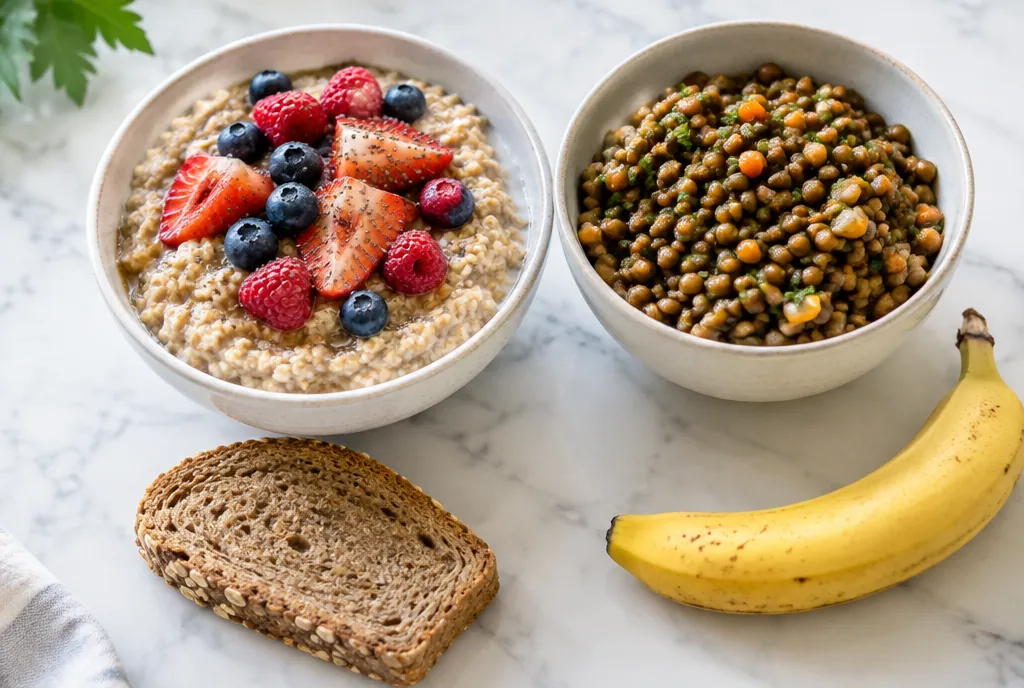 AI image
Side by side
| Criteria | Glycemic index (GI) | Glycemic load (GL) |
|---|---|---|
| What it measures | How quickly and how much a carbohydrate food raises blood sugar compared with a reference, on a 0–100 scale | The blood sugar impact of a portion, combining a food's GI with the amount of carbohydrate it contains |
| Considers portion size? | No — based on a fixed 50 g of digestible carbohydrate | Yes — reflects the carbohydrate in the amount eaten |
| Common categories | Low 55 or less, medium 56–69, high 70–100 | Low 10 or under, medium 11–19, high 20 or more |
| Practical use | Comparing similar carb foods, such as whole vs refined grains | Thinking about how much of a carb food you actually eat |
| Limitations | Ignores portion size; affected by ripeness, processing and what it is eaten with | Still relies on GI values; cut-offs are somewhat arbitrary |
If you have looked into blood sugar and food, you have probably come across two terms: glycemic index (GI) and glycemic load (GL). They sound similar and are related, but they answer slightly different questions. This comparison explains what each one measures, how you might use them, and why neither should become a strict rule.
Glycemic index: how quickly a carb raises blood sugar
Harvard's Nutrition Source describes the glycemic index as a ranking of carbohydrate foods on a scale from 0 to 100, based on how quickly and how much they raise blood sugar after eating. The University of Sydney, which runs a widely used GI database, explains that GI is measured by giving 10 or more healthy people a portion of food containing 50 grams of digestible carbohydrate and comparing their two-hour blood glucose response with a reference (glucose).
Harvard's Nutrition Source uses these categories:
- Low GI: 55 or less
- Medium GI: 56 to 69
- High GI: 70 to 100
Several things change a food's GI, according to Harvard's Nutrition Source: how processed it is (refined grains tend to be higher than whole grains), how finely it is ground, how much fiber it has, how ripe it is, and whether it is eaten with fat or acid.
Glycemic load: how much carb you are actually eating
The big gap in GI is portion size. GI is based on a fixed amount of carbohydrate, not on how much of the food a person usually eats. A 2018 review in the journal Nutrients by Vega-López, Venn and Slavin explains that glycemic load was introduced to fill that gap by combining a food's GI with the amount of available carbohydrate in a given portion.
Harvard's Nutrition Source summarizes it simply: a food's glycemic load is its glycemic index multiplied by the amount of carbohydrate it contains. It gives these categories:
- Low GL: 10 or under
- Medium GL: 11 to 19
- High GL: 20 or more
In practice, this means a food with a fairly high GI can still have a low GL if a normal serving contains only a small amount of carbohydrate. Likewise, a large portion of a medium-GI food can add up to a high GL.
What the research says about usefulness
It is tempting to treat GI or GL as a scorecard for "good" and "bad" foods. The evidence suggests caution.
Harvard's Nutrition Source notes that some large observational studies have linked diets with a higher GI to a greater risk of type 2 diabetes and heart disease, while the relationship between GI and body weight is less well studied and remains controversial.
The 2018 Nutrients review looked more broadly at trials and observational studies. Its authors described the relationship between GI and disease outcomes as equivocal, and concluded it is unlikely that the GI of a food or diet on its own is linked to disease risk or health outcomes. They also noted that the cut-off points for low and high GI and GL were set somewhat arbitrarily, and that low-GI foods often contain more fiber, which makes it hard to separate the two. The authors suggested that measures like fiber and whole grains may be better predictors of health outcomes.
How to use these ideas without getting lost in numbers
You do not need to memorize GI tables. A few practical takeaways line up with both concepts:
- Choose minimally processed whole grains more often than refined grains.
- Favor high-fiber foods such as beans, lentils, vegetables and whole fruit.
- Pay attention to portion sizes of starchy foods, which is the main idea behind GL.
- Combine carbohydrate foods with protein, healthy fats and vegetables.
When to talk to a professional
GI and GL are general tools. They do not tell you how your own body responds, and they do not replace guidance from your care team. If you have diabetes or prediabetes, a registered dietitian or diabetes care and education specialist can help you decide whether GI or GL is worth using in your meal planning. If you take insulin or other diabetes medicines, talk to your doctor before making major changes to how you eat, and never change your medication on your own.
Pros and cons
Glycemic index (GI)
A 0–100 ranking of how quickly a carbohydrate food raises blood sugar compared with glucose, using a fixed amount of carbohydrate.
Pros
- Useful for comparing similar carbohydrate foods
- Widely published in food databases
- Highlights the effect of processing and fiber
Cons
- Does not account for how much you eat
- Values vary with ripeness, cooking and food combinations
- Evidence linking GI alone to health outcomes is mixed
Glycemic load (GL)
Combines a food's GI with the amount of carbohydrate it contains, so it reflects a realistic portion.
Pros
- Accounts for portion size
- Shows that a high-GI food can have a low impact in small amounts
- Closer to how people actually eat
Cons
- Requires knowing both GI and carbohydrate content
- Inherits the variability of GI values
- Cut-off points are somewhat arbitrary
Frequently asked questions
Which is more useful, GI or GL?
GL is generally more practical because it accounts for portion size, but both are rough guides. Overall diet quality, such as fiber and whole grains, matters more than either number.
Should I avoid all high-GI foods?
Not necessarily. A high-GI food eaten in a small portion can have a low glycemic load, and eating it with protein, fat or fiber also changes the response. A dietitian can help you decide what makes sense for you.
This article is general education, not medical advice. It can't diagnose anything or tell you how to change a treatment. If you have diabetes or prediabetes, take medication, are pregnant or have another health condition, talk to your doctor, registered dietitian or diabetes care team before changing how you eat or move. Health disclaimer
Sources
- Harvard T.H. Chan School of Public Health, The Nutrition Source — Carbohydrates and Blood Sugar nutritionsource.hsph.harvard.edu
- University of Sydney, Glycemic Index Research and GI News — About Glycemic Index glycemicindex.com
- Vega-López S, Venn BJ, Slavin JL. Relevance of the Glycemic Index and Glycemic Load for Body Weight, Diabetes, and Cardi pmc.ncbi.nlm.nih.gov
We link to health institutions, published guidelines and original research. See our editorial policy.
Recipes
Put it on your plate
-
Dinner
-
Dinner
-
Snacks
-
Dinner